Geophysis Research & Development
A Founder’s Note
At Geophysis, our mandate is simple: generate valuable intellectual property by mastering the interaction between matter and the electromagnetic spectrum.
We seek to develop high-performance materials and technologies that solve consequential problems today while establishing the foundation for transformative applications on Earth, in orbit, and beyond.
Michael Jones Founder, Geophysis Research & Development
Leadership & strategic partnerships
- Michael Jones — Founder michael@geophysis.com
- Dr. Rishi Khan — Lead Systems Architect rishi@geophysis.com
- Dr. Volodymyr Shatalov — Lead Theoretical Physicist volodymyr@geophysis.com
- Kit Andrew — Executive Vice Chairman, Strategy and Global Partnerships kit@geophysis.com
Founder | Geophysis Research & Development
Michael Jones
Advanced Materials • Electromagnetics • Predictive Technology • Intellectual Property
Advanced Technology & Materials Development
A History of Engineering Solutions Through Material Innovation
Michael Jones’ work in advanced materials and electromagnetic technologies extends back decades and predates the creation of Geophysis Research & Development.
His technology development has consistently followed a common principle: identify a significant real-world problem, understand the physical mechanism involved, and engineer a practical solution through materials, structure and electromagnetic control.
Identify the problem. Understand the physics. Engineer the material. Control the environment. Create the solution.
IntelliBrella — Spectral Protection
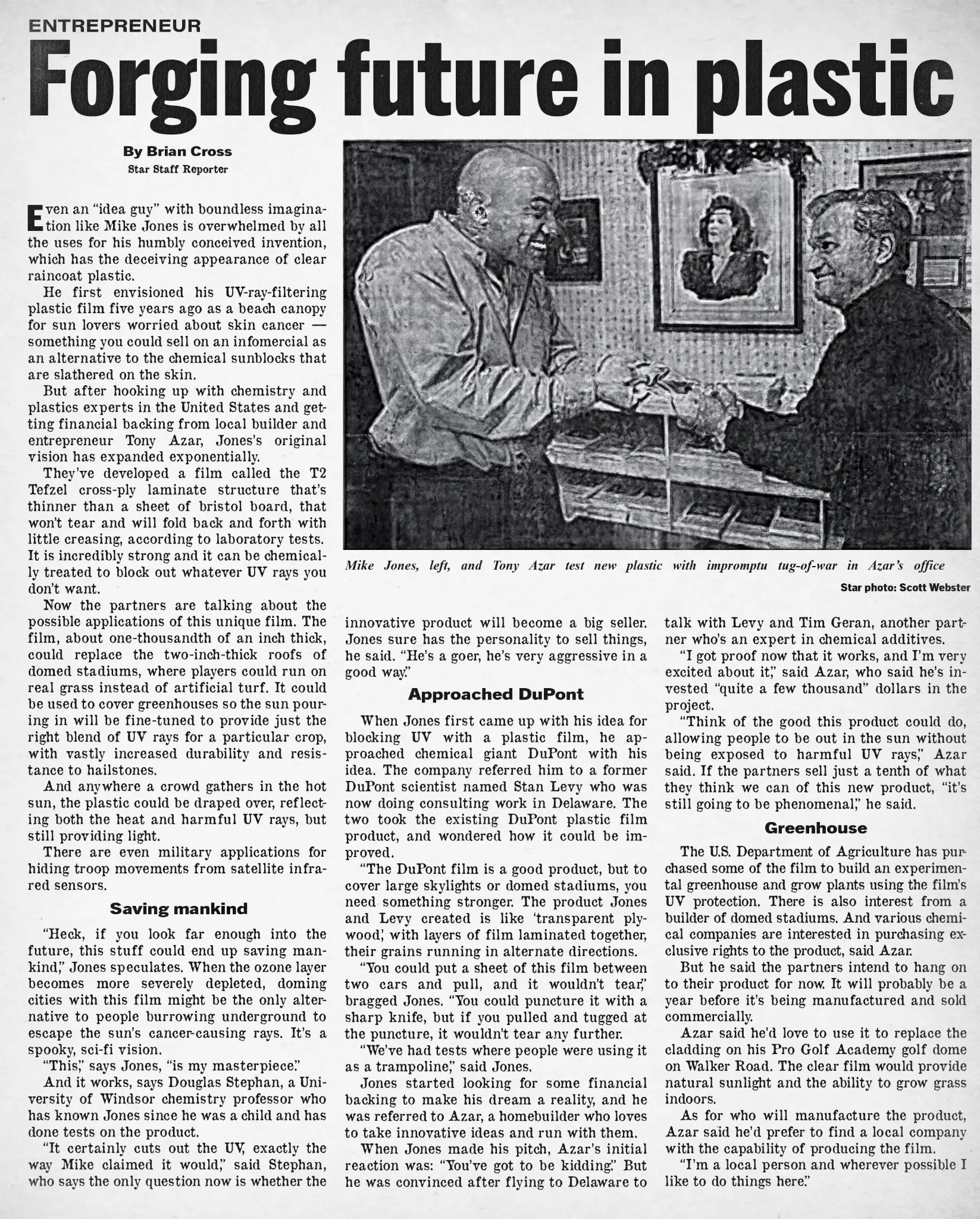
Michael was the original inventor of IntelliBrella, an early technology concept designed to provide physical UV protection through an engineered transparent canopy rather than relying exclusively on topical chemical sunscreen.
The concept was developed in consultation with Professor Douglas Stephan, former Dean of the Department of Chemistry at the University of Toronto, in response to growing concerns surrounding chemical exposure associated with conventional sunscreen formulations and the need for alternative approaches to UV protection.
IntelliBrella represented an early application of a principle that remains central to Geophysis today: control the electromagnetic environment at the source of exposure through engineered materials rather than simply treating its effects afterward.
The technology subsequently evolved into the Sunslinger platform within Geophysis R&D.
This work established Michael’s longstanding interest in spectral management, transparent materials and practical electromagnetic protection.
Control the electromagnetic environment at the source of exposure through engineered materials.
Cross-Ply Laminate Development
L.E.V.Y. — Laminated Electromagnetic Variance Yield
Michael subsequently worked with Stanley B. Levy, an accomplished inventor and engineer whose career included pioneering contributions associated with angioplasty, on the development of an advanced cross-ply laminate structure engineered to combine exceptional strength with optical clarity.
The resulting material was regarded at the time as the world’s strongest clear plastic film.
The collaboration provided Michael with direct experience in advanced polymer structures, laminate architecture, material reinforcement, optical performance, engineering optimisation and commercialisation.
The resulting material platform was named L.E.V.Y. — Laminated Electromagnetic Variance Yield, in honour of Michael’s mentor Stanley B. Levy and the work they accomplished together.
“L.E.V.Y. — Laminated Electromagnetic Variance Yield — was named in honour of my mentor, Stanley B. Levy. His influence on my work extended far beyond the material itself, and naming the technology after him was a way of recognising that contribution.”
— Michael Jones
Performance is determined not only by what a material is made from, but by how its components are structured and engineered to interact with their environment.
From Materials to Electromagnetic Control
These early developments established the foundation for Michael’s current work at Geophysis.
The company is extending this experience into advanced polymeric and composite materials, including ETFE, PVDF and TPU, and investigating how engineered multilayer structures can be designed to control electromagnetic and thermal interactions.
The objective is to develop materials capable of selectively transmitting, reflecting, absorbing, filtering, redirecting or otherwise managing electromagnetic energy across relevant portions of the spectrum.
Potential engineering variables
- Material composition
- Layer architecture
- Cross-ply orientation
- Thickness
- Surface treatments
- Conductive and dielectric inclusions
- Nanoparticles and functional fillers
- Spectral-selective structures
ETFE & Extreme-Environment Materials
ETFE is of particular interest because of its combination of low mass, transparency, durability and environmental resistance.
These characteristics make it a potentially valuable substrate for advanced membrane structures, controlled-environment agriculture, architectural systems and future aerospace applications.
Geophysis is exploring how ETFE and related substrates could become more than passive construction materials by incorporating engineered electromagnetic and thermal functionality directly into their architecture.
Potential applications extend from terrestrial infrastructure and agriculture to future aerospace and off-world structures, where weight, durability, radiation exposure, thermal management and electromagnetic control become critical engineering considerations.
From passive substrate to engineered electromagnetic and thermal architecture.
The Geophysis Trajectory
IntelliBrella L.E.V.Y. / Cross-Ply Laminates ETFE / PVDF / TPU Electromagnetic Materials Engineering GGEE
-
IntelliBrella
Physical control of UV exposure.
-
L.E.V.Y. / Cross-Ply Laminates
Advanced transparent material architecture.
-
ETFE / PVDF / TPU & Advanced Substrates
Engineered material platforms.
-
Electromagnetic Materials Engineering
Spectral and thermal control.
-
Geophysis Generalized Emergence Engine
Computational discovery, optimisation and IP generation.
The Geophysis Generalized Emergence Engine (GGEE) represents the next stage of this progression: an integrated computational architecture intended to combine established scientific platforms, advanced materials modelling, electromagnetic simulation, optimisation and artificial intelligence to accelerate the discovery of proprietary technologies.
The underlying philosophy has remained consistent for decades:
Identify the problem. Understand the physics. Engineer the material. Control the environment. Create the solution.
That continuity—from IntelliBrella and advanced transparent laminates to electromagnetic materials and computational discovery—provides Geophysis with a practical foundation for pursuing significant opportunities across consumer products, infrastructure, agriculture, energy, aerospace and future off-world technologies.
A continuous progression from practical materials innovation to computational discovery and intellectual-property generation.
Geophysis Research & Development Research & Development — Matter, Engineered.
Leadership and architectural foundation
Engineering the future of multispectral materials.
At Geophysis Research & Development, we do not simply build technologies; we architect the foundational frameworks that govern how physical systems interact with their environment. As we prepare for our strategic commercial engagements in Dubai, our mission is anchored by a singular objective: delivering uncompromising, physics-based superiority in extreme environments.
To achieve this scale of innovation, leadership requires more than visionary strategy — it demands world-class execution. That is why our technical architecture is spearheaded by Dr. Rishi Khan, serving as our Lead Systems Architect.
Dr. Khan represents the absolute pinnacle of high-performance computing, exascale architecture, and hardware-software co-design. His pedigree — spanning decades of foundational research with national institutions, DARPA, DOE, and mission-critical defence and medical industries — provides Geophysis with an unmatched engineering engine.
Architectural excellence: the Rishi Khan portfolio
Integrating Dr. Khan’s extensive background into our core infrastructure ensures that every Geophysis innovation, from our advanced thermal-mitigation fabrics to the Geophysis Generalized Emergence Engine (GGEE), is built on battle-tested, industrial-grade foundations.
-
Exascale computing & neural operators
Proven leadership in scaling complex parametric partial differential equations (PDEs) and Fourier Neural Operators (FNOs) across massive distributed systems, allowing our simulation engines to process atomic-to-macro transitions with mathematical rigour.
-
Hardware-software co-design & edge AI
Deep expertise in deploying quantised models, Vision Transformers, and Graph Neural Networks (GNNs) directly onto specialised hardware — FPGAs and embedded NPUs — ensuring our field-deployable assets operate with real-time, low-latency precision.
-
Advanced cryptography & system trust
Mastery over high-security architectures, including Fully Homomorphic Encryption (FHE) acceleration and Physically Unclonable Functions (PUFs), guaranteeing uncompromising data integrity and operational security for defence and enterprise deployments.
-
Rigorous validation standards
Decades of experience engineering systems under stringent regulatory frameworks — such as FDA Class II/III standards and mission-critical defence specifications — bringing aerospace-grade reliability to our entire product pipeline.
Built for global scale
The intersection of Dr. Khan’s systems architecture and our broader theoretical frameworks allows Geophysis to bridge the gap between abstract physics and tangible, market-ready supremacy. As we expand our footprint into international markets starting in Dubai, our technological backbone is engineered to withstand the most rigorous scrutiny from elite technical partners, enterprise clients, and global investors.
We are not just designing materials. We are redefining the architecture of survival and adaptation.
Dr. Khan in conversation
The Future of AI and High-Performance Computing
Dr. Rishi Khan, in conversation on Smart Business Revolution.
Scientific foundation
Theoretical physics: Dr. Volodymyr Shatalov.
At Geophysis Research & Development, our scientific mandate is to develop technologies grounded in rigorous physical principles and capable of addressing complex problems involving materials, energy, and the electromagnetic spectrum. A central component of this effort is the expertise of our Lead Theoretical Physicist, Dr. Volodymyr Shatalov.
Holding a Doctor of Sciences in Physics and Mathematics and bringing approximately five decades of research and development experience, Dr. Shatalov provides Geophysis with an exceptional depth of theoretical and mathematical perspective. His contribution to the Geophysis Generalized Emergence Engine (GGEE) is focused on establishing and evaluating the mathematical and physical foundations required for a rigorous predictive framework.
Our approach is deliberately integrative. Rather than attempting to recreate established scientific capabilities, GGEE is intended to incorporate proven computational methods within a coordinated computational architecture. We are not building a collection of disconnected simulations.
Established methods GGEE incorporates
- Density Functional Theory (DFT)
- Molecular and materials modelling
- Electromagnetic simulation
- Transport theory
- Optimisation
- Emerging AI-based approaches
An independent physics perspective
Dr. Shatalov’s expertise provides an important independent physics perspective as these disciplines are brought together. His role is to examine the underlying assumptions, mathematical relationships, boundary conditions, and physical consistency of the models while identifying opportunities where deeper theoretical treatment may provide additional predictive value.
This distinction is fundamental to the Geophysis approach. We are developing an architecture in which established scientific methods can exchange information, inform one another, and contribute to a common discovery and optimisation process.
Through the combination of established computational science, rigorous theoretical physics, systems architecture, and advanced optimisation, Geophysis is working toward a predictive research environment capable of addressing increasingly complex engineering challenges — from extreme terrestrial environments to future aerospace and off-world applications.
Dr. Shatalov’s decades of experience provide an essential scientific perspective as that architecture evolves, helping ensure that ambition remains coupled to mathematics, physics, and disciplined scientific inquiry.
The ultimate objective is practical: to accelerate the identification of high-performance materials, structures, and electromagnetic technologies that can become valuable intellectual property.
Strategy and global partnerships
Commercial leadership: Kit Andrew.
Kit Andrew is Executive Vice Chairman, Strategy and Global Partnerships at Geophysis Research & Development, guiding corporate strategy, strategic alliances, commercialisation, and international business development.
He works with leadership to expand markets, build high-value relationships, and accelerate global adoption of Geophysis’ technologies.
UAE Strategic Partnerships & Global Reach
Engineering for a Nation Building the Future
GEOPHYSIS & THE UAE
The United Arab Emirates is pursuing an ambitious technology agenda focused on advanced science, artificial intelligence, energy transformation, sustainable infrastructure, advanced materials, smart systems, and space technologies. Its 2030-oriented initiatives increasingly emphasise energy efficiency, environmental technology, advanced materials and manufacturing, food and water security, and the development of globally competitive research and innovation capabilities.
The electromagnetic spectrum is an underlying component of many of these challenges.
Solar radiation, thermal radiation, wireless communications, spectrum utilisation, energy transmission, photonics, sensing, advanced materials, and space systems all depend upon the ability to understand and increasingly control electromagnetic interactions. The UAE’s telecommunications regulator, for example, maintains an extensive national framework for spectrum planning, compatibility analysis, emerging radio technologies, and space services.
This is precisely where Geophysis is positioning itself. Our objective is the generation of valuable intellectual property for electromagnetic governance.
Through the Geophysis Generalized Emergence Engine (GGEE), we are developing an integrated computational architecture intended to connect established scientific methods with advanced optimisation and artificial intelligence to accelerate the discovery of high-performance materials and electromagnetic technologies.
Our objective is the generation of valuable intellectual property for electromagnetic governance—technologies capable of controlling, redirecting, filtering, absorbing, transmitting, converting, or optimising electromagnetic energy for practical applications.
The opportunity extends across energy, architecture, agriculture, advanced manufacturing, communications, photonics, defence and protection, aerospace, and ultimately off-world infrastructure.
The opportunity is not confined to a single product or market. It extends across systems in which electromagnetic interaction determines performance.
Our UAE Connection
Geophysis Research & Development feels right at home across the UAE, where our team has spent decades building genuine business relationships. We know the people, the area, and local traditions inside and out. Because we maintain direct, ongoing contact with our trusted regional network, every conversation is efficient and natural.
When interest sparks, it’s handled seamlessly by our handpicked UAE specialists who know precisely how to deliver with warmth, respect, and deep cultural fluency.
That network understands the landscape, relationships, opportunities, and decision-making environment necessary to bring the right people to the table. Its reach across Dubai and the broader UAE provides Geophysis with an extraordinary bridge to investors, strategic partners, technology collaborators, institutional leaders, and decision-makers capable of evaluating and supporting ambitious technological initiatives.
Our objective is not simply to enter the UAE market.
It is to bring the right technology, the right architecture, and the right people together with the right opportunities.
Where GGEE provides the technological architecture, our scientific and systems leadership provides the expertise, and our existing technology initiatives provide practical applications, our regional network provides a critical connection to the ecosystem in which those capabilities can be evaluated, financed, developed, and commercialised.
Dubai is therefore not merely a destination for Geophysis.
It represents a strategic environment in which our vision of electromagnetic governance, advanced materials, predictive engineering, and intellectual-property generation can intersect with one of the world’s most ambitious technology and infrastructure ecosystems.
The objective is alignment. The right technology, the right architecture, and the right people together with the right opportunities.
Geophysis Research & Development Research & Development — Matter, Engineered.
Bring us your toughest questions.
The future depends on the answers.